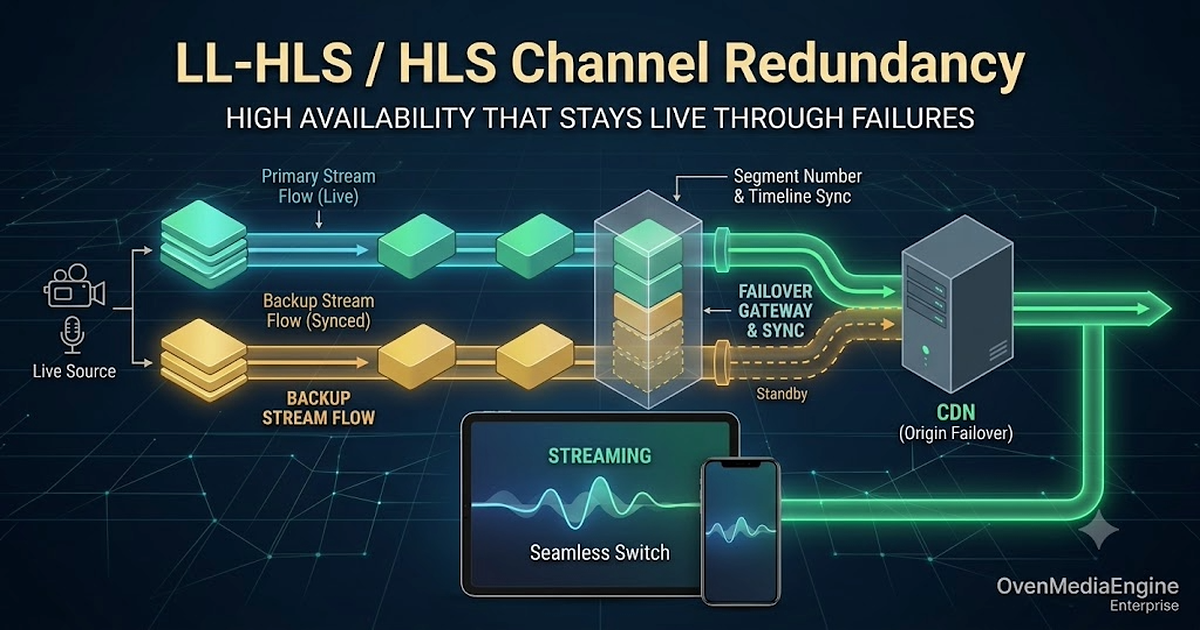
Real LL-HLS / HLS channel redundancy comes down to keeping two Origins, Primary and Backup, in sync. Here is what has to line up in the encoder-origin path, especially the timeline and the segment numbers.
Making a live channel redundant comes down to one thing: keeping the output of the two Origins behind your CDN, Primary and Backup, synchronized so that the player can switch between them at any time and keep playing without interruption.
With VOD this is easy. The files are pre-rendered and static, so any Origin serves the exact same bytes, and putting Primary/Backup behind a CDN is all it takes. Live is different. Each Origin cuts the stream into segments in real time, so even when both receive the same broadcast, their output does not line up on its own.
This post covers what has to line up to make a live channel truly redundant, and in particular how to synchronize the encoder-origin path.
OvenMediaEngine is an open-source and sub-second latency streaming server capable of handling large-scale and high-definition streams. It can be installed and used in various environments, such as servers, CDNs, and Clouds. Today, we will show you how to easily use OvenMediaEngine by installing Docker on an AWS EC2 instance.